Deployment Type Where You Push to the Same Server Over and Over Again
Speed is the central to modern software evolution. The monolithic all-or-nothing paradigm of traditional waterfall software development has largely been replaced by rapid iterative techniques that support development and release. These techniques get by several names, including continuous integration, continuous commitment and continuous deployment.
While each technique offers slight differences, the common emphasis on continuous iteration has inverse the nature and power of software development. Businesses tin can go software to marketplace faster, test innovative new features or architectures while minimizing risk and cost, and effectively refine products over time.
Such iteration relies on well-planned and active pipelines designed to support multiple iterations in diverse stages of the evolution bike simultaneously -- and keep entire development teams constantly busy. As one build is pushed to deployment, the next build undergoes testing, while the very latest build in the wheel is coded.
Permit's take a closer look at these continuous approaches, see how each works, counterbalance the tradeoffs and consider best practices.
What do CI and CD mean?
The close relationship between continuous integration, continuous delivery and continuous deployment tin sometimes be confusing, especially when combined in the cyclical procedure known every bit CI/CD. It'due south of import to understand the differences between each arroyo.
Continuous integration (CI) focuses on the early on stages of a software evolution pipeline where the lawmaking is congenital and undergoes initial testing. Multiple developers work on the same codebase simultaneously and brand frequent commits to the code repository. Build frequency tin exist daily or fifty-fifty several times per mean solar day at some points in the project'southward lifecycle. These small, frequent builds enable easy and low-run a risk experimentation, besides every bit the power to easily scroll back or abandon undesirable outcomes.
CI employs a variety of tools and automation techniques to create builds and shepherd them through initial testing, such equally sniff or unit of measurement testing, forth with more comprehensive integration testing. CI is as well noted for its rapid and detailed feedback. The express nature of each iteration ways that bugs are identified, located, reported and corrected with relative ease.
Ultimately, CI ends when a build successfully completes initial testing and is set up to move to more comprehensive testing. Grooming might include packaging the build into a deployable epitome, such as a container or virtual motorcar (VM) image, earlier making it available to defended testers.
Continuous commitment (CD) picks upwards where CI leaves off. It focuses on the later stages of a pipeline, where a completed build is thoroughly tested, validated and delivered for deployment. Continuous delivery can -- but does not necessarily -- deploy a successfully tested and validated build.
CD likewise relies heavily on tools and automation to take a build through advanced testing, including functional, user acceptance, configuration and load testing. These validate that the build meets requirements and is set for use in a production environment. Once more, small incremental iterations ensure that any problems revealed in testing are identified and remediated speedily and less expensively than traditional software evolution approaches.
Continuous deployment (also CD) follows the aforementioned basic steps as continuous commitment. The principal difference betwixt delivery and deployment is that continuous deployment automatically deploys each validated build to production. Past comparison, continuous delivery typically only stages the validated build for manual deployment or other man authorization.
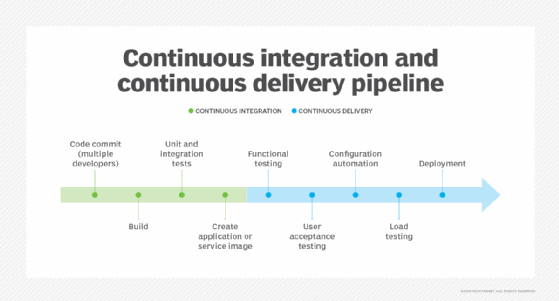
Continuous deployment farther accelerates the iterative software development process by eliminating the lag betwixt build validation and deployment. Even so, such a paradigm could also allow undetected flaws or vulnerabilities to slip through testing and current of air up in production. For many organizations, automated deployment presents besides many potential risks to enterprise security and compliance. These teams adopt the continuous delivery paradigm in which humans review a validated build before it is released.
The common theme through these 3 continuous paradigms is a heavy reliance on automation and testing to bulldoze the procedure. Ideally, a developer need just "printing the button" to whisk a new build from the code repository through testing and on to commitment or deployment. This tantalizing proposition depends on the quality of the testing, the integrity of the automation behind it, and the careful attention of testers and software engineers.
Benefits and challenges of a CI/CD pipeline
In a CI/CD pipeline, everything is designed to happen simultaneously: Some software iterations are being coded, other iterations are being tested and others are heading for deployment. All the same, CI/CD involves important tradeoffs between benefits and drawbacks.
The benefits of a CI/CD pipeline include the following:
- Efficient software evolution. Smaller iterations (steps) allow for easier and more efficient testing. The express scope of lawmaking in each new iteration, also as the scope to test information technology, makes it easier to find and fix bugs. Features are more than readily evaluated for usefulness and user acceptance, and less useful features are hands adjusted or fifty-fifty abased before further development is wasted.
- Competitive software products. Traditional software development approaches tin can accept months or years, and formalized specifications and requirements aren't well suited to changing user needs and expectations. CI/CD development readily adapts to new and changing requirements, which enables developers to implement changes in subsequent iterations. Products developed with CI/CD tin can reach market faster and with more than success.
- Liberty to fail. CI/CD'south rapid cyclicality enables developers to experiment with innovative coding styles and algorithms with far less risk than traditional software evolution paradigms. If an experiment doesn't piece of work out, it probably won't always see production and can exist undone in the adjacent rapid iteration. The potential for competitive innovation is a powerful driver for organizations to use CI/CD.
- Better software maintenance. Bugs can take weeks or months to prepare in traditional software development, but the constant flow of a CI/CD pipeline makes it easier to address and ready bugs faster and with better confidence. The production is more than stable and reliable over fourth dimension.
- Ameliorate operations back up. Regular software releases keep operations staff in melody with the software's requirements and monitoring needs. Administrators are better able to deploy software updates and handle rollbacks with fewer deployment errors and needless troubleshooting. Similarly, It automation technologies tin can help speed deployments while reducing setup or configuration errors.
Despite these compelling benefits, concern leaders and evolution teams must consider some of the potential pitfalls of CI/CD pipelines:
- Dedication to automation. CI/CD relies on the consistency of an established tool set and strong automation to build, test and deploy each build. This demands a serious intellectual investment to implement and manage the automation, which can involve a steep learning curve. Changes to the evolution procedure or tool set can profoundly impact the CI/CD pipeline, so CI/CD is frequently employed in mature and active development environments.
- Staff discipline and planning. A CI/CD procedure cannot bring total value to the business if it'southward non constantly generating new builds, testing release candidates and deploying selected candidates to production. This requires careful planning and practiced project direction skills. Developers must attach to established development guidelines to ensure quality, style and architectural standards. Meanwhile, business concern leaders and project stakeholders can be extremely uncomfortable with automated deployments in continuous deployment paradigms, and meetings for manual get/no-go deployment decisions can be fraught with stress over unknown or unforeseen consequences. This tin crusade unnecessary delays -- all while new builds are coming through the pipeline.
- Advice and collaboration. No corporeality of automation and tooling is a substitute for good advice and collaboration among developers and project stakeholders. These interactions facilitate the rapid, efficient experimentation that makes CI/CD and so powerful. Automation and tools are simply ways to that cease.
Attributes of a good CD/CD pipeline
So what does effective CI/CD really expect similar? Here are some common characteristics of a expert CI/CD process:
- Speed. A CI/CD pipeline can have numerous steps and parts, but a build should exist able to move through the pipeline (integration, testing, delivery and even deployment) in curt order -- perhaps but minutes to complete an integration, and a few hours for testing cycles to finish. If it takes days to move a build through the pipeline, a neat deal of valuable time is probably being wasted, and the process needs fine-tuning.
- Consistency. The processes and components used in one place or wheel are exactly the same in all places and cycles. For instance, if a build results in a Docker container, that container is the object that'southward tested and moved through the pipeline to delivery or deployment. Developers can write scripts and create automation processes with confidence that such efforts volition be successful and deliver the desired results every time. Processes that innovate variations or manual steps tiresome the pipeline and invite errors and inefficiency.
- Tight version control. Well-documented repositories or components and builds allow rapid restoration of previous builds when new builds or deployments go awry. Good version control facilitates fast, accurate and confident rollbacks -- perhaps to the previous working version -- whenever the need arises.
- Automation. Extensive automation moves new lawmaking through integration, testing and delivery or deployment with little, if any, manual interaction. Ideally, a human does picayune more than than develop and commit lawmaking, so await for an approved pull request and approval earlier a deployment, if needed. A pipeline that depends on manual steps and processes is deadening and prone to errors.
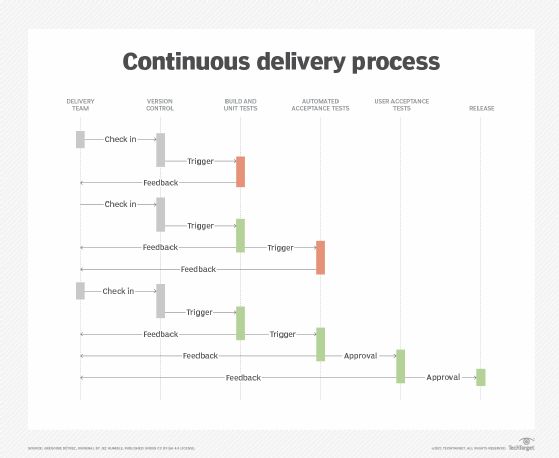
- Integrated feedback loops. A CI/CD pipeline is a loop that yields countless iterative steps to a completed project -- and each stage also offers a loop dorsum to the beginning. A problem with the source code won't generate a build. A problem with the build won't movement into testing. A problem in testing or after deployment will demand source fixes. The sooner a problem is identified, the faster, easier and cheaper it is to fix, keeping the overall pipeline in motion.
- Security throughout. Oversights and mistakes in programming and testing can create vulnerabilities and expose software to malicious activeness. Thus, it is disquisitional to infuse security all-time practices throughout the CI/CD pipeline. Tools such as vulnerability checkers can assistance spot potential security flaws in the code flowing through the pipeline, while additional security evaluations should accept place during the testing phase.
What are the stages of a CI/CD pipeline?
The CI/CD pipeline combines continuous integration, delivery and deployment into four major phases: source, build, examination and deploy. Each phase uses highly detailed processes, standards, tools and automation. Just every bit physical products made in a factory may benefit from customized manufacturing machines, software pipelines are oft tailored to arrange the specific needs of the projection and the business concern.
Source. The first phase in a CI/CD pipeline is the creation of source code, where developers interpret requirements into functional algorithms, behaviors and features. The tools employed for this depend on whether the development team is working in Java, .Cyberspace, C#, PHP or endless other evolution languages. Integrated evolution environments (IDEs) are often selected because they support a specific linguistic communication in addition to various code-checking features, such as basic error detection, vulnerability scanning and adherence to established coding standards. Other source lawmaking and pipeline support tools, including code repositories and version control systems such every bit Git, typically course the foundation for edifice and testing phases.
There is no single pipeline for source creation. A business may accept multiple source portions of the CI/CD pipeline depending on the various projects in development -- such as a server-side platform using C++, website applications using Coffee and mobile applications using Become. Similarly, coding features may vary betwixt IDEs and projects due to different standards or vulnerabilities between projects, such every bit enterprise production systems versus a consumer app.
Build. The build process draws source code from a repository, establishes links to relevant libraries, modules and dependencies, and compiles (builds) all these components into an executable (.exe) file. Tools used in this stage also generate logs of the process, denote errors to investigate and correct, and notify developers that the build is completed.
Equally with source code creation, build tools typically depend on the selected programming language. A evolution group may employ independent tools to generate a build; many IDEs incorporate such build capabilities, which means they effectively support both the source creation and building phases within a CI/CD pipeline.
A build phase may employ additional tooling, such as scripts, to interpret the executable file into a packaged or deployable execution environment, such as a VM (complete with an operating system and related components) or a container, such as Docker container with libraries and dependencies.
Test. While source code has already completed some static testing, the completed build now enters the next CI/CD phase of comprehensive dynamic testing. This usually starts with basic functional or unit testing to verify that new features and functions work as intended, and regression testing to ensure that new changes or additions do not accidentally break any previously working features. The build also undergoes a bombardment of tests for integration, user credence and performance. If errors occur during testing, the results are looped back to developers for analysis and remediation in subsequent builds.
Automation is particularly critical in the CI/CD test phase, where a build is subjected to an enormous array of tests and test cases to validate its functioning. Human being testing is typically too slow and subject to errors and oversights to ensure reliable or objective testing outcomes. Test specialists create comprehensive exam cases and criteria but depend on test tools to implement testing and validation in a busy pipeline.
Deploy. Ultimately, the build passes the testing stage and is considered a candidate for deployment in a production environment. In a continuous delivery pipeline, information technology is sent to human being stakeholders, approved and so deployed. In a continuous deployment pipeline, the build automatically deploys every bit before long every bit it passes its test suite.
The deployment step typically involves creating a deployment environment -- for example, provisioning resources and services within the data eye -- and moving the build to its deployment target, such as a server. These steps are typically automated with scripts or through workflows in automation tools. Deployments too usually connect to fault reporting and ticketing tools to observe unexpected errors afterwards the build is deployed and alarm developers. Users can also submit bug tickets to denote real or perceived errors with the release.
Even the most wildly optimistic deployment candidates are rarely committed to production without reservation. Deployments frequently involve boosted precautions and alive testing periods, including beta tests, A/B tests, blue/green tests and other crossover periods to curtail or roll dorsum unforeseen software bug and minimize the business organization impact.
What is an example of a CI/CD pipeline?
There is no single right way to build a CI/CD pipeline. Every pipeline can utilise different tools and include variations or alternate pathways to support projection types with different scopes and sophistication. Regardless of the approach, an ideal CI/CD pipeline should run into iii fundamental goals:
- Improve the software's quality.
- Make software development faster and more agile.
- Heave confidence in software deployment to production.
Permit'southward examine a typical CI/CD pipeline, consider the activities within each phase and note several possible tools to tackle them.
Source
Developers write lawmaking using editors or IDEs. A evolution squad may employ several editors or IDEs to support multiple languages for unlike projects.
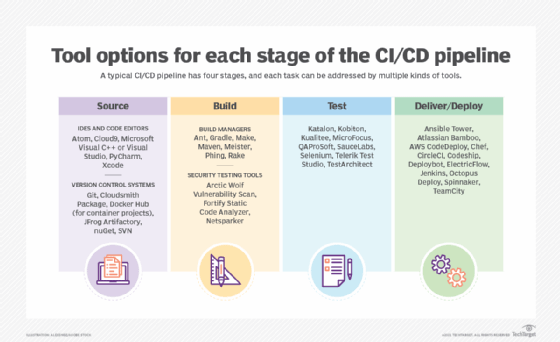
Tools: Examples of software IDEs include Atom, Cloud9 IDE, Microsoft Visual C++ or Visual Studio, PyCharm and Xcode.
The source code is typically stored in a common shared repository, or repo, where multiple developers tin admission and piece of work on the codebase at the same time. Repos also mostly hold other parts of the software development process, such as artifacts (of compilation and linking), libraries, executables, modules, examination scripts and suites. Repos provide a comprehensive version control system, which ensures developers work on the latest codebase and integrate the latest components in the build procedure.
Tools: GitHub, based on Git, is a popular repo; other examples of repositories include GitLab, Cloudsmith Packet, Docker Hub for container projects, JFrog Artifactory, NuGet and SVN.
Once a developer commits changes to the codebase, those changes are saved to the version control system in the repository, which automatically triggers a new build.
Build
The build process typically involves multiple steps: Fetch the source code components from the repo, compile lawmaking, and link libraries and other modules. The upshot is a unproblematic executable file, or a more circuitous assembly such as a deployable container or VM. All of the artifacts involved in the build process are typically retained in the repository. If in that location are problems or errors in the build, the process stops and problems are reported back to the developers for remediation. Typical problems include functional errors, such as a divide-by-zero math error, or missing components -- for instance, a required library or module is non present in the build manifest.
Tools: Many IDEs include build tools natively tailored to the selected programming language. Alternatively, standalone build tools include Ant, Gradle, Make, Maven, Meister, Phing and Rake. Jenkins is a popular CI engine, but there are Jenkins alternatives such as Atlassian Bamboo, AWS CodePipeline, CircleCI, GitHub Actions and TeamCity.
The build stage may also include some basic testing for vulnerabilities, such as software limerick assay (SCA) and static awarding security testing (SAST).
Tools: Examples of SAST tools include Arctic Wolf Vulnerability Assessment, Fortify Static Code Analyzer and Netsparker. Vendors with SCA tools include Checkmarx, Kiuwan, Snyk, Synopsys and Veracode.
If the build completes successfully and passes initial test scans, information technology moves to the CI/CD testing phase.
Exam
While some testing is ethnic to the build procedure, near happens after the build is successfully completed. This complex phase involves numerous steps and goals, including the post-obit:
- Unit testing validates new features and functions added to the build.
- Dynamic application security testing (DAST) scans the build for security flaws, such equally weak passwords or missing credentials.
- Interactive awarding security testing (IAST) analyzes traffic and execution flow to observe security issues, including those in third-party or open source components.
- Regression testing verifies that changes or additions do non harm previous features.
- Integration testing ensures the build operates with other applications or services.
- User acceptance testing assesses whether users are able to utilize new features and functions as intended.
- Performance testing ensures the build operates every bit required under load.
Developers and software testing specialists create test atmospheric condition that provide input to the build and compare the bodily response or output to the expected response. If they lucifer, the test is considered successful and the build moves on to the next test. If they do not match, the divergence is noted, and error information is sent dorsum to the development team for investigation and remediation.
Tools: There are hundreds of exam tools applicable through these tests. Each supports some level of automation, and some can perform multiple types of tests. Popular testing tools include Appian, Katalon, Kobiton, Kualitee, Micro Focus, Qaprosoft, Sauce Labs, Selenium, Telerik Exam Studio and TestArchitect.
Not all builds that successfully complete the testing phase move into the deployment phase. Some builds may simply represent interim steps that need validation just are not still fix for deployment. For example, developers may examination an incomplete feature subset, flesh out the remaining feature subset in a subsequent build and and then deploy information technology in its entirety.
Deploy
A build that successfully passes testing may be initially deployed to a test server; this is sometimes called a test deployment or pre-production deployment. A script copies a build artifact from the repo to a desired test server, then sets upwardly dependencies and paths.
One time on a exam server, the build can be configured to simulate a production environs; for instance, access to examination databases and other applications may be enabled for "real-world" functional and performance evaluations. Much of this relies on automation merely may involve human testing to shake downward nuances of the build. This is sometimes called an alpha or development release, and involves just a small base of well-informed testers and users.
Pre-production deployment is typically the endpoint for continuous delivery pipelines. Once the build is completely validated and stakeholders have conviction in the build's stability and integrity, it can exist deployed to an actual product environment. In a continuous deployment pipeline, once the build passes pre-deployment testing, it is automatically deployed to production.
To amend safety and guard against unforeseen consequences, a new build may exist deployed in parallel to the electric current build in an A/B configuration, also called beta testing. This testing gradually expands to larger user groups until all users are on the new build. At that point, the previous build is retired, and its calculating resource freed for other applications.
Tools: There are many dedicated deployment tools, including Ansible Tower, Chef, Codeship, ElectricFlow, Jenkins, Octopus Deploy, Spinnaker and TeamCity. Deployments likewise may involve awarding performance monitoring (APM) tools and other types of instrumentation to bank check and report on an application's health.
How practice you implement a CI/CD pipeline?
In that location is no one manner to set upwards a CI/CD pipeline. Precise steps vary between tools and the process to implement -- and that'due south by design, to tailor an incredibly agile pipeline that meets the needs of the business and its projects.
Still, there are common steps and decisions at each phase of pipeline structure that generally utilize to any CI/CD procedure:
- Select a version control system to maintain code repositories. Determine if you need a hosted version, or a hosting provider. Major deject providers also offering options here, such every bit Azure DevOps.
- Create repositories to firm application source lawmaking and pipelines.
- Determine what build, or CI, server to utilize. This tin can be cocky-hosted, such every bit Jenkins, or a third-political party option such as GitHub Actions, CircleCI or Azure Pipelines.
- Implement a task in the pipeline that compiles awarding source code into a build. In some setups, this will generate a Docker epitome.
- Run bones tests on the code (static analysis, style checks) to ensure its quality and consistency with organizational guidelines.
- The build should now generate an artifact, or container image, published to a store or registry.
- Initiate further testing on the build, every bit listed previously (functional, security, user acceptance, etc.). If predetermined thresholds are not met, fail the stage. Publish results of tests and lawmaking coverage so they are easily bachelor.
- One time the software build passes tests, it is gear up for final preparations to production deployment. This may include multiple staged environments, such as blue/green and canary deployments.
Note that CI/CD based in the deject office basically the aforementioned only rely heavily on tools and services native to the cloud provider'southward platform. This may require specific steps. For example, here is a walkthrough to build a CI/CD pipeline based on Azure DevOps and GitHub.
CI/CD implementation encounters some specific challenges, also. Here are two major ones to picket out for:
- Express testing. Allocating and coordinating resources and intellectual investment to configure examination environments and construct test cases is a common problem for CI/CD pipelines. Continuous evolution involves multiple code commits and parallel testing demands that frequently result in configuration conflicts and limited/forgotten test cases. This tin can lead to errors slipping through the test stage and degrading the pipeline'due south efficiency. There's no substitute for skilled and knowledgeable software testers and well-documented requirements and goals.
- Fixing bugs. Pipelines are designed to provide feedback loops back to developers who tin can fix bugs in a new build. Finding a bug is easy plenty, simply information technology can be hard to identify the specific developer responsible to set up that section of code. This makes it harder to hold developers responsible for their work and can obfuscate the demand for more training. Logging, team communication and copious documentation can help determine the location of the bug and identify the developers to exist involved in its resolution.
CI/CD pipeline best practices
A business and its development teams can utilize various methods to get the almost from a CI/CD pipeline. These CI/CD best practices can assist organizations derive even more value from them.
Start small. CI/CD brings speed and agility, so give the process time to evolve and enable developers to endeavour different tools and steps. A business might start with a CI pipeline and add CD afterwards. Small-scale filler projects are ideal places to endeavour new tools and techniques that can enhance a broader pipeline.
Define success. Sympathise the intended benefits, such every bit faster lawmaking building or lower mistake/rework rates, and then implement metrics to measure those criteria. Compare the metrics against pre-pipeline functioning and rails those metrics as the pipeline evolves. This makes it easier to see the pipeline's value, spot problems over time, and invest in ways to build and enhance the CI/CD pipeline.
Certificate processes. Oftentimes overlooked and underappreciated, documentation is an essential part of the development pipeline. It lays out the process and tools for all developers and business users, and explains how everything is related and configured. Plus, it can help troubleshoot problems. Documentation also contributes to an organization's compliance and security posture, enabling leaders to audit activities.
Call up about operations. Active evolution paradigms, such equally DevOps and continuous deployment, comprehend both operations and development roles. Developers must understand both deployment and operations, and take greater buying of the software'due south reliability and performance. Concern and project leaders must foster and reinforce this attitude shift.
Focus on feedback. Feedback inside the CI/CD pipeline is most constructive when every step -- and every participant -- actively works to spot and accost problems to salve time and work efficiently. This starts with spotting errors in the source lawmaking and continues all the style through testing and deployment. For example, find and gear up a syntax error in the source code at the build stage, rather than waste time and endeavor during the testing phase. Categorizing and analyzing errors tin also help businesses amend the development skills and processes.
Infuse security throughout. Security scanning tools at the code level (SAST and SCA tools) are handy for early vulnerability and error diagnostics only tin produce a large number of fake positives. Security scanning at the test level (DAST and IAST tools) requires the software to be built and running, which means errors are caught later in the pipeline where bug fixes are more than time-consuming and plush. Select the all-time security scanning tools for the tasks at hand, and utilise those tools to automatically update the bug tracking system and automatically generate tickets for fast examination and remediation.
Besides, think about the security of the pipeline itself: Improper authorization and authentication can expose tools and repositories to malicious actions. Secure tools and repositories, use logs to track user access to them and flag unusual activities -- such as downloads to IP addresses outside of the corporate LAN.
Embrace continuous testing. During the source and build stages, perform SCA, SAST and other basic code scans for fashion and security standards. When the build is completed, apply a bombardment of established exam conditions using examination tools. Showtime with simple functional validation, and systematically expand testing to more circuitous and comprehensive integration, in-depth security (such as DAST) and performance. Staff must carefully construct tests and test cases to validate the features and functionality of each new build as the builds, the project and fifty-fifty the projection'due south requirements evolve. Frequently added new features require frequent tests and examination cases.
Foster communication. Integration and delivery piece of work together but are often implemented separately and handled by different teams, such equally coders and testers. A CI/CD pipeline that functions smoothly requires timely and articulate communication and collaboration between different teams across the pipeline; otherwise, it tin easily break down with unnecessary delays.
Avoid waste. Creating and maintaining a CI/CD pipeline incurs diverse costs for tools, infrastructure and resources. Inefficient utilize of any of these -- underutilized or unused tools, overallocated Information technology infrastructure for testing and deployments, poor coordination, insufficient evaluation of processes or tools -- can boring development and impair developer productivity. CI/CD pipelines are dynamic entities that crave frequent refinement and regular developer training to operate efficiently and reliably.
This as well means fugitive less obvious areas of inefficiencies. Don't make ten different builds in the same day if at that place is no practical way to exam and deploy those x builds in the same day. Teams and project effort must reflect the most effective utilize of the pipeline.
Enhance the ecosystem. CI/CD and other agile pipelines are ecosystems composed of tools tied together with processes and automation, with myriad alternating paths and steps for unlike products. Teams should always evaluate new tools and refine the processes to keep the overall pipeline as smooth and efficient as possible.
Source: https://www.techtarget.com/searchsoftwarequality/CI-CD-pipelines-explained-Everything-you-need-to-know
0 Response to "Deployment Type Where You Push to the Same Server Over and Over Again"
Post a Comment