How Early Can You Do a Paternity Test
Introduction
"Who is the father of the kid" and "who is my biological father" are questions that arise often, not simply in plots for movies and novels, but in courts or simply for peace of listen. Paternity tests offer answers to these questions with scientific evidence.
What do you want to acquire from Whole Genome Sequencing?
With current technology, Dna paternity tests results have an accurateness of over 99.99%. Farther, results are often available in less than a week. Only, how exactly do these tests work and where can you get one?
Edited by Christina Swords, Ph.D.
DNA inheritance
Each ane of united states is born with a unique genetic blueprint. Dna is this unique "fingerprint" that makes up a person'southward genetic material. This genetic material is derived from the DNA of both parents. Half the Deoxyribonucleic acid is inherited from the biological female parent and the other half from the biological father. This is the premise on which paternity testing is congenital. Get-go, samples of DNA from the child and the potential father are collected. By analyzing the results, the probability of parentage is adamant.
History of paternity testing
Tests for paternity identification and family relationship linking have been used for more than 100 years. In the early twentieth century, blood typing was the about mutual method.
This method takes advantage of the heritability of blood types, which are A, B, AB, and O. Because claret blazon is encoded in DNA, a child inherits one allele from each parent. And so, assessing a kid'south blood blazon can give insights near the potential blood types of the parents.
For example, a person with blood blazon O must accept 2 O alleles, one inherited from each parent. But information technology is non always this directly-forrad to determine. An individual with blazon A claret can accept either ane A allele and one O allele, or 2 A alleles. See Figure i for a nautical chart with a child's blood blazon possibilities.
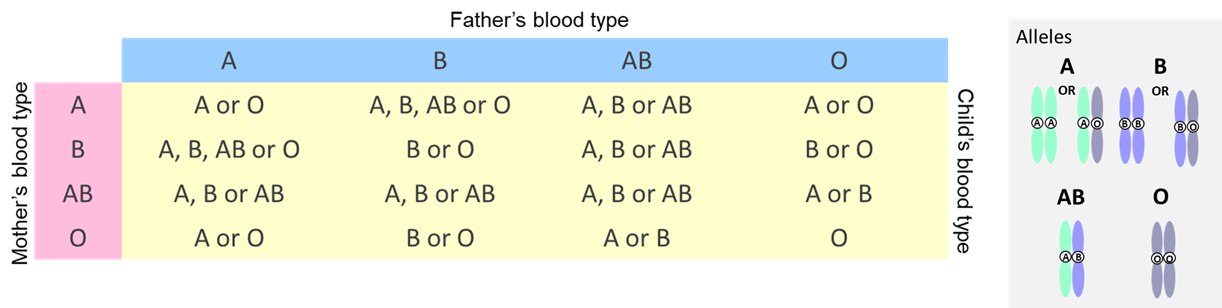
Unfortunately, this type of examination is limited in the information it can provide regarding a child'due south parents. Information technology cannot confirm a biological relationship like fatherhood. Instead, it can merely human action to exclude a potential parent based on possible blood blazon.
With advances in DNA testing technology, paternity testing has shifted towards accurate confirmation of paternity rather than simple exclusion.
The science behind Deoxyribonucleic acid-based paternity testing
The DNA fingerprinting technology beginning described in 1985 has now go a powerful tool for paternity and motherhood testing. It first became available for in 1988 and has since evolved. The current gold standard employs a molecular biology technique that enables exponential amplification of fragments of DNA.
The procedures are simple, just requiring a small sample of actual fluids/tissue from the child and the potential biological male parent. This sample is typically gathered from a blood draw or past swabbing the within of the cheek.
Paternity testing based on Dna has become the virtually accepted method for proof of biological relationship. Since half a person'south Deoxyribonucleic acid is inherited from the mother and the other half from the male parent, comparison of DNA sequences tin can identify parentage.
Sibling DNA tests tin likewise be performed in cases of a deceased or missing parent. These sibling tests can be used to verify if two or more individuals share a common parent. The pattern of inheritance of genetic markers betwixt siblings are different from that between a parent and child. While identical twins share 100% of the same Dna, full siblings only share ~ fifty% of the Deoxyribonucleic acid. One-half-siblings merely share 25% of the Dna, on average.
Methods for paternity testing
DNA paternity testing involves collection of a Dna sample from a child and the potential father. The Deoxyribonucleic acid sample may exist collected using multiple methods. The nearly common methods are collecting a blood sample or a swab from the inside of the cheek. The DNA is fragmented using one of multiple approaches and the fragments are run on a gel that separates them by size creating a distinct banding pattern (Figure 2). The patterns of these bands provide information about the biological relationships, every bit described below.

There are two methods for generating DNA fragments. The first is brake fragment length polymorphism (RFLP) that utilizes the variation in Dna sequences recognized past brake enzymes to cutting DNA in pieces. The second is polymerase chain reaction (PCR) that takes advantage of rapid amplification of DNA, either at unique sequences or short tandem repeats (STR).
RFLP
Brake Fragment Length Polymorphism is a method that takes reward of unique Dna patterns in specific regions across an individual's genome. A big family unit of proteins known as "restriction enzymes" can identify and cut DNA at these unique sites. As a outcome, fragments of variable sizes are produced depending on a person's Dna contour.
By looking for similar patterns in the digested fragments between the individual and the potential male parent, paternity is determined (Figure 2). Since each restriction enzyme has a unique sequence it recognizes, small differences in the DNA will result in cut at different sites. By comparison the pattern of the Deoxyribonucleic acid fragments cut by the restriction enzyme, paternity tin can be confirmed. Although this technique has been used for paternity testing and forensics, it tin can be a very slow process.
PCR
Polymerase Chain Reaction is a method where fragments of an individual's Dna are copied billions of times in a "concatenation reaction". This allows large amounts of DNA to be created from just a small amount of template DNA. These fragments are and then labeled with fluorescent tags that allow for visualization of the fragments on a gel. If roughly one-half of the fragments analyzed to match the child and the potential begetter, paternity is confirmed with an accuracy of 99.99% (Figure ii).
PCR has become the gold standard for paternity testing, and boasts a college accuracy than RFLP. Additionally, the PCR-based method requires a relatively smaller sample of DNA than the RFLP method.
DNA sampling for paternity testing before nativity
While paternity testing tin can exist hands carried out by collecting blood or cheek swabs from individuals, information technology is challenging if the test needs to be carried out before birth.
Questions often arise earlier birth and early testing is desirable, especially if the woman considers terminating the pregnancy.
There are three means to collect a DNA sample from an unborn child: Chorionic Villus Sampling (CVS), amniocentesis, and the Non-Invasive Prenatal Paternity (NIPP) examination.
Chorionic Villus Sampling (CVS)
This Dna sample drove method samples chorionic villi which are little finger-similar projections on the placenta in the uterus. The genetic makeup of the chorionic villi and the fetus are identical. To obtain the chorionic villi tissue sample, a catheter tin be inserted through the neck into the placenta (transcervical method). A needle can also be inserted through the belly and uterus into the placenta (transabdominal method).
This procedure is guided by ultrasound and due to loftier risk of complications, a doc's consent is needed. This testing is normally done between 10-13 weeks of pregnancy.
Amniocentesis
This DNA collection method uses amniotic fluid that surrounds the fetus. The amniotic fluid contains cells that are shed by the fetus and contain genetic material that can be analyzed. To obtain a sample of the fluid, a long, thin, hollow needle is pierced through the pare, into the uterus, and into the amniotic sac, to draw a sample.
Although invasive and just to be carried out with a doctor's consent, risks of miscarriage is considered less than i%. This test can be performed in the second trimester, betwixt the 14-xx weeks of pregnancy.
Non-Invasive Prenatal Paternity (NIPP)
This is the well-nigh accurate prenatal paternity test that is non-invasive. The process is based on analysis of free-floating DNA from the fetus constitute in the mother'south bloodstream. This examination requires only a simple claret sample collection from the female parent, and a claret describe or cheek swab from the declared male parent.
This exam can exist performed every bit early as the 8th week of pregnancy. The accuracy of the test is 99.9% and recommended by the American Pregnancy Association. If the woman was pregnant recently, there may be fetal cells in the systemic circulation that may invalidate the exam results.
Due to the availability of a safe and reliable non-invasive test, the two invasive techniques are instead simply reserved for diagnosing genetic diseases of the fetus.
Legal issues surrounding paternity testing
Both legal and not-legal tests are available. Non-legal testing includes have-habitation Dna tests that provide the same information as legal paternity tests. The difference is that information cannot be used in a courtroom of police and is non considered court-admissible. Only courtroom-ordered tests may be used in court cases and for legal purposes.
The laws and regulations surrounding paternity testing vary widely beyond the earth. It is important to consider the rules in your country before proceeding with testing.
In the United States, paternity testing is fully legal and does not require the consent of the mother. There are country-to-state variations in the legal implications of a test, specially for child support or custody. For example, New York has unlike testing regulations than other states. The state requires authorization from a physician or a lawyer for the test. Every bit a upshot, testing at home is also not allowed for NY residents.
In Canada, testing is more regulated with certified labs merely having the approval to perform paternity tests.
The Uk had no restrictions on testing till 2006. According to the Human
Tissue Act, any testing can just be performed with the consent of the individual.
Paternity testing is legal in China. It is legally required by the government to investigate any kid born outside the one-child policy before a birth certificate is issued. Peace-of-mind tests are also popular in China for confirming parentage.
France has fabricated it illegal to perform whatever tests on the human trunk including genetic testing, unless ordered by court or to identify a deceased individual. Deoxyribonucleic acid paternity testing is punishable by a €xv,000 fine and upward to a twelvemonth in prison.
Companies offer Deoxyribonucleic acid paternity testing services
Different paternity tests vary in costs. Piece of cake DNA offers various testing services. This includes legal tests, abode paternity tests, immigration DNA tests, sibling DNA tests, Non-Invasive Prenatal tests, and forensic tests. Their home testing services outset from $199, and take an accurateness of 99.9%, without testing the mother. With the mother's DNA sample, the accuracy of results upwardly to 99.99%.
Amazon sells the STK Paternity Examination, a take-dwelling house paternity testing kit for the parent and child. The DNA tests are carried out in an accredited laboratory. This is bachelor for $99.99 with results available in less than a calendar week.
Testing kits are also bachelor at many drugstores. One such exam is the HomeDNA paternity Test (formerly IDENTIGENE), sold by HomeDNA. The kit is bachelor for $fourteen.99 with an boosted fee of $139 for lab services. Results are returned in two business days, with one-day and same-day options bachelor for an additional fee. You lot can read more about HomeDNA testing in our review.
Yous may also be interested in learning nigh DNA testing during pregnancy!
Source: https://nebula.org/blog/paternity-test/
0 Response to "How Early Can You Do a Paternity Test"
Post a Comment